
As Rizal Day approaches, it is an ideal time to reflect on José Rizal’s enduring legacy as a symbol of Filipino courage and nationalism. While his recognition as a national hero is often linked to American rule, his significance was already recognized even before that. Lipa, a pioneering town in this commemoration, celebrated the first Rizal Day with an event highlighted by the inauguration of a school named after the hero, Instituto Rizal. A news article from January 1, 1899, authored by Fidel A. Reyes, captures this historic occasion, offering insight into the profound patriotism of the Lipeños and their reverence for Rizal.
Below is a translation of the said article.
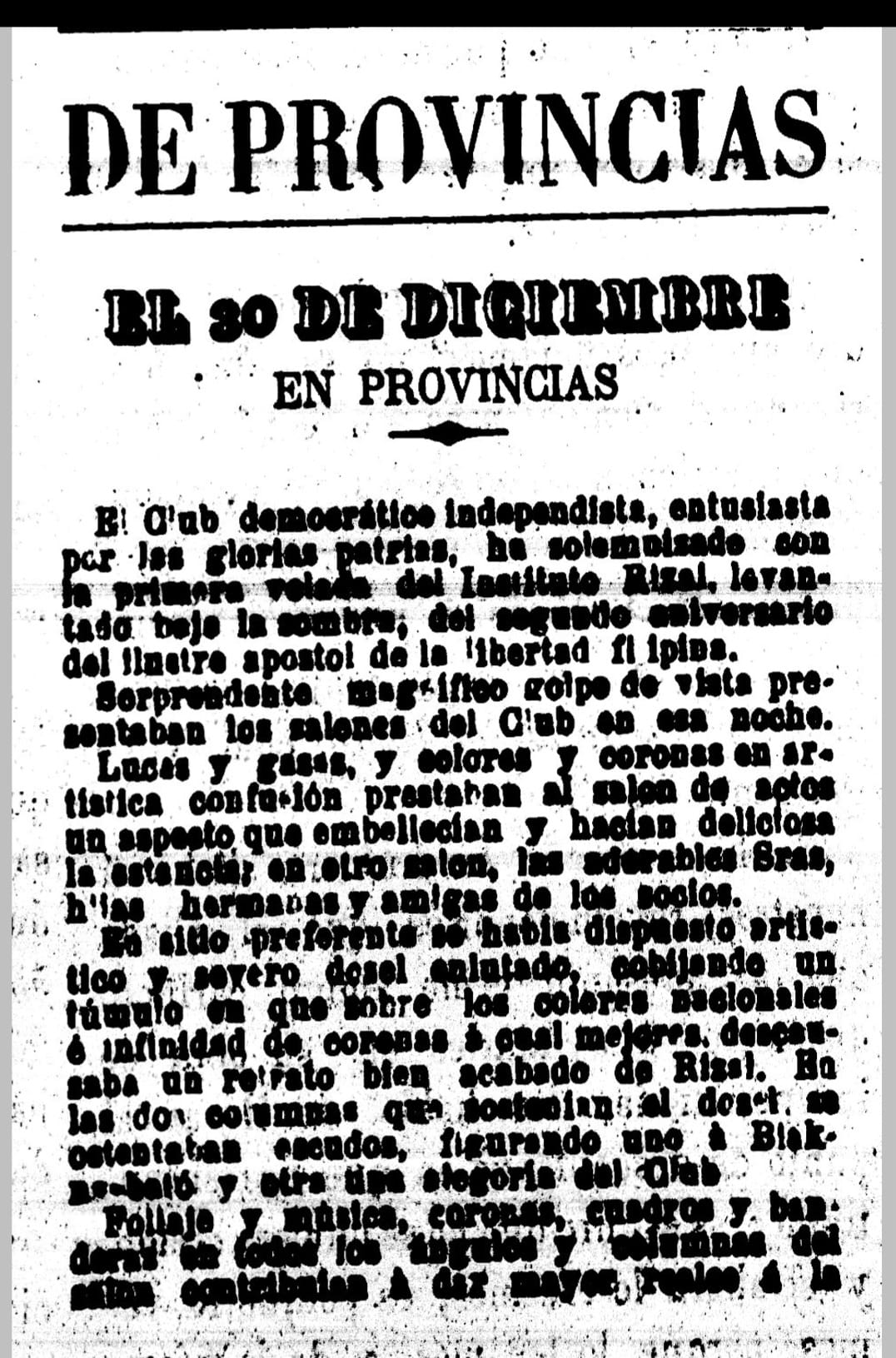
| THE 30TH OF DECEMBER IN THE PROVINCES The Club Democrático Independista, filled with patriotic fervor, celebrated the inaugural evening of the Instituto Rizal, established under the shadow of the second death anniversary of the illustrious apostle of Filipino liberty. |
| The halls of the Club presented a stunning and magnificent sight that night. |
| Lights and draperies, colors and wreaths in artistic disarray gave the event hall an atmosphere that beautified the space and made the stay delightful. In another hall, the lovely ladies—wives, daughters, sisters, and friends of the members—gathered. |
| In a prominent place, an artistic and somber canopy was arranged, draping a tomb beneath which rested a portrait of Rizal, set against the national colors. On the two columns supporting the canopy, shields were displayed, one depicting Biak-na-Bato and the other an allegory of the Club. |
| Foliage, music, wreaths, paintings, and flags adorned every corner and column of the hall, enhancing the celebration and, more than anything, the spirit of fraternity that animated everyone present. |
| Among the many wreaths, which carried heartfelt dedications, the following caught attention: those from the Solís, Katigbak (M.), Losada, Librea, Aguilera, and Dimayuga (C.) families; the triangular wreath from General Malvar’s headquarters, a beautiful creation by Señoritas Consuelo [Losada] and Soledad [Aguilera]; the wreath from the youth of Lipa; and others from Señoritas Inés, Lorenza, and Macaria Katigbak, among many others we cannot recall. |
| After the ceremony, pastas, liquors, sandwiches, and sweets were intimately served. |
| Our pen is inadequate to detail the finer points of this patriotic celebration. The only thing we can say is that there was a true outpouring of beauty from the attendees, enthusiasm from the organizers, and good taste and hospitality from the club’s event committee. The program for the evening was as follows: |
| PRELIMINARY SPEECH BY FIDEL A. REYES |
| 1st part Funeral March by the orchestra band. Filipinas eight-line stanzas in Spanish recited by the young Guillermo Katigbak. En mi retiro: Rizal’s poem recited by Sr. Numeriano Dimayuga. El deber de los niños (The Duty of Children): a dialogue recited by Manuel Roxas, Alfredo Librea, and Guillermo Katigbak. |
| INTERMISSION La Traviatta, a violin and piano fantasy. |
| 2nd part The Philippines before Rizal’s Tomb: Tagalog poem recited by Teodoro Kalaw. El grito de Independencia (The Cry for Independence), a poem composed by Sr. [Gregorio] Aguilera and recited by the young Alfredo Librea. 30 de Diciembre: a poem recited by the young Manuel Roxas. A Rizal (To Rizal): A Spanish sonnet recited by Bernardo Solís (Jr.). Mi ultimo pensamiento (My last thought): Castilian alejandrinos by Rizal, recited by Teodoro Kalaw. Final Hymn: All for the Fatherland; lyrics by Rizal and music by Maestro [Pablo] Obando. |
| The handmade programs and invitations were beautiful, truly worthy of the occasion they were created for. |
| On the following night, New Year’s Eve, the younger members of the Club, sponsored by its esteemed President Mr. Aguilera, and supported by Vice President Dr. Roxas, organized an impromptu farewell to the year, which turned out to be incredibly lively and festive, both due to the timely decorations and activities and the charming participation of the beautiful daughters of this blessed part of the country. As with the previous night, they transformed the Club’s halls into a delightful retreat for several hours. |
| At midnight, a humorous pantomime depicting the exit of 1898 and the entrance of 1899 caused general amusement among the attendees. The figures of 1899, symbolized by a brave “sandatahan” (warrior), and 1898, represented by a very ugly friar and a battered soldier, were driven out by the warrior to the sounds of a funeral march and the tolling of agonizing bells. |
| At the stroke of twelve, the 1898 figure, battered by sticks, hid in a castle that the “sandatahan” demolished to the tune of the national march and bell chimes. Standing on the castle’s ruins, the “sandatahan” raised our flag high and saluted the audience, wishing them a happy New Year. |
| At the same moment, a curtain was drawn to reveal the allegory of 1899, symbolized by the Philippines, freedom, science, the arts, and literature, all perfectly arranged. Meanwhile, the scene representing 1898—consisting of rubble, old objects, funeral wreaths, Spain, and the Theocracy—was closed. |
| We applaud the event committee for their good taste and hard work. Both celebrations were well-attended by the club’s regular and honorary members, including the brave General Malvar on the first evening. |
| As for the ladies, we regret not being able to publish their names, as we fear we may not remember them all, which could unintentionally offend some. This, we admit, is our greatest fear. Suffice it to say that they were very elegant and truly captivating. |
| We wish that events like these be held at the people’s house (club) more often. It pleases us deeply to see how the Club is fulfilling its noble purpose of strengthening the spirit of unity, which is so necessary for the greatness of our country in all fields. |
| Tomorrow, January 2, the Instituto Rizal of the Club, which has not yet been officially inaugurated, but already held its first evening in honor of the name it carries, will be formally opened with classes to follow immediately. Negro [Fidel A. Reyes] Lipa, January 1, 1899. |
The commemoration of the first Rizal Day exemplifies the deep reverence and national pride that the Filipino people had even during the early days of their struggle for independence. Through acts of tribute like those in Lipa, the legacy of Rizal’s patriotism was preserved and honored. This event not only remembered Rizal’s sacrifice but also reinforced the indomitable spirit of the Filipino people in their pursuit of freedom.
Source: “El 30 de Diciembre, En Provincias,” La República Filipina, 27 de enero 1899.
 Herencia Lipeña